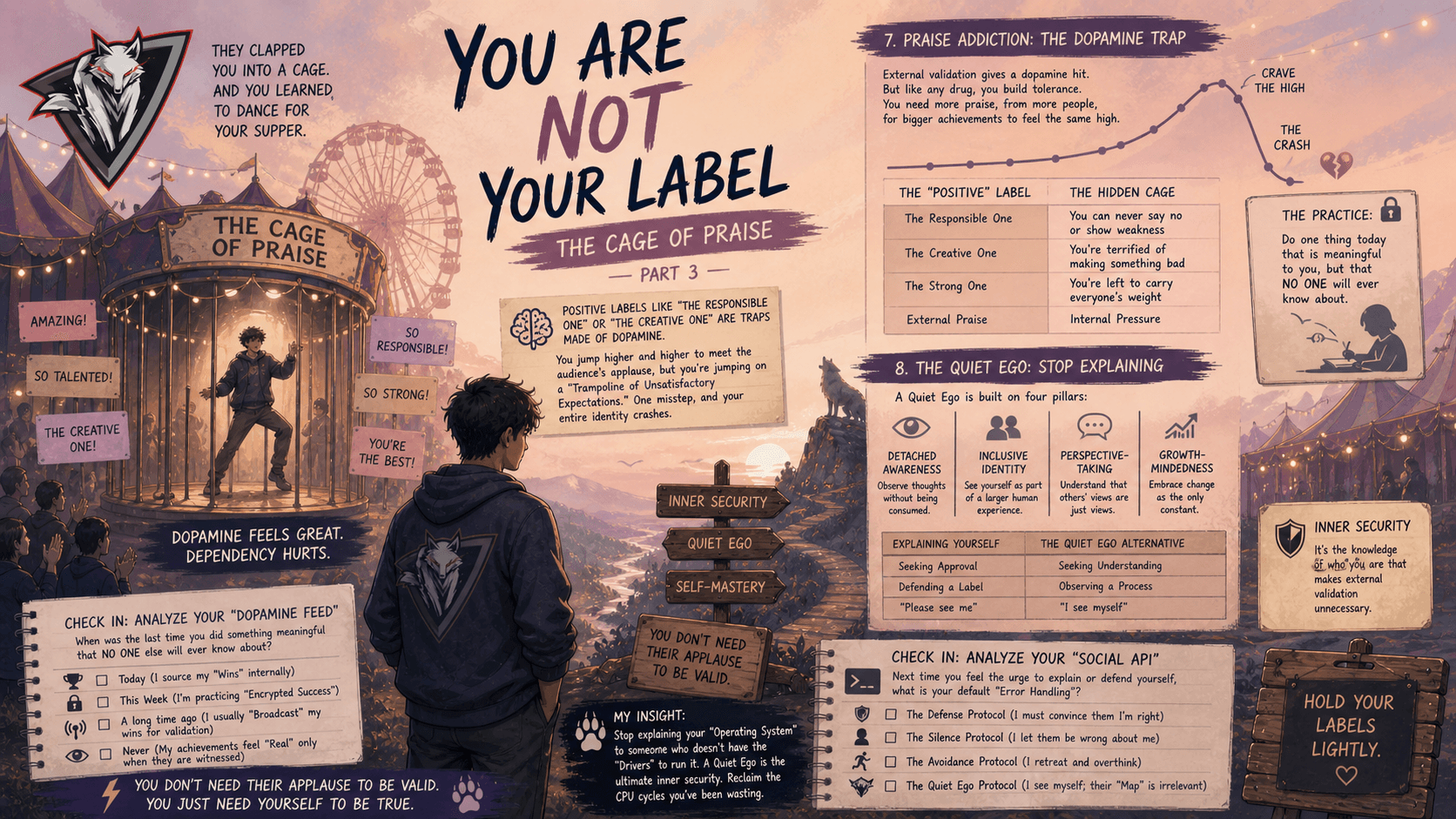
"They clapped you into a cage. And you learned to dance for your supper."
In Part 2, we discussed the performance of self. Today, we focus on the audience and how external validation creates a cage of praise.
"Praise is a golden cage that keeps you performing."
You strive to meet the applause of others, but you are jumping on a fragile surface of endless expectations. One misstep, and your entire sense of self collapses because it only existed in their approval.
Analyze your search for approval. When was the last time you did something meaningful that NO ONE else will ever know about?
Specifically, we’re talking about the dopamine-soaked trap of performing for other people's labels. Because as it turns out, the most dangerous labels aren't the ones people use to insult you—they're the ones they use to praise you.
7. Praise Addiction: The Dopamine Trap
Subtitle: The dopamine trap of performing for other people's labels.
External validation triggers a surge of dopamine in your brain. It feels great. But like any drug, you develop a tolerance. You need more praise, from more people, for bigger achievements to get the same hit.
Research shows that 55% of people rely on others' opinions for self-worth. This creates what I call the Dopamine Pit: when the validation stops, you crash. You feel empty, uninspired, and anxious because your "self" only exists when someone else is claping.
"The opinions of others are a volatile wave."
If your self-worth is tied to the reactions of those around you, your peace of mind is always at the mercy of their shifting moods. Finding validation within is the only way to build a resilient, unshakable sense of self.
🐺 My Insight: The Trampoline of Unsatisfactory Expectations
When you’re labeled "the creative one" or "the strong one," you’re handed a trampoline. You jump higher and higher to meet people's expectations. But the trampoline is made of unsatisfactory expectations. No matter how high you jump, it's never enough, and you're always one misstep away from falling off.
| The "Positive" Label | The Hidden Cage |
|---|---|
| "The Responsible One" | You can never say no or show weakness |
| "The Creative One" | You're terrified of making something bad |
| "The Strong One" | You're left to carry everyone's weight |
| External Praise | Internal Pressure |
The Practice: Source dopamine from internal validation. Do one thing today that is meaningful to you, but that no one will ever know about. Notice how it feels to have a secret success that belongs only to you.
8. The Quiet Ego: Stop Explaining
Subtitle: What happens when you stop explaining yourself.
The need to explain yourself is often a defense mechanism against the fear of being mischaracterized. Every time you say "I only did that because..." or "I'm not really like that...", you are begging the world to "See me correctly."
I had to develop a Quiet Ego out of necessity. As I shared in Part 1, I was surrounded by people who used shallow knowledge of personality types to cage me. My first instinct was to scream the truth—to explain that personality books are just starting points for genuine connection.
But I realized that for some people, the cage is the point. They aren't looking for the truth; they are looking for a shortcut to judgment. If you spend your life explaining yourself to people who are committed to misunderstanding you, you will lose your soul in the process.
This is especially true in toxic environments fueled by gossip. Rumors can make you dislike innocent people. When you are surrounded by noise, it's easy to judge someone based on what others are saying about them. But a wise observer knows better: Be wise, get to know them for yourself, then form your own opinion. The one talking to you about them may be the exact person you need to stay away from.
"You don't need to explain your values to someone committed to misunderstanding you."
A quiet ego is your ultimate inner shield. You don't need to prove your truth to those who are not ready to hear it. Reclaim the emotional energy you have wasted defending who you are.
A Quiet Ego isn't about being silent. It's a self-identity that is balanced—neither self-centered nor self-effacing. It's built on four pillars:
- Detached Awareness: Observing your thoughts without being consumed by them.
- Inclusive Identity: Seeing yourself as part of a larger human experience.
- Perspective-Taking: Understanding that others' views are just views.
- Growth-Mindedness: Embracing change as the only constant.
When you have a Quiet Ego, you stop needing their "Correct Map" of you. You know who you are, and that is enough.
🐺 The "Youniverse" Perspective
In my Youniverse assessments, we see that everyone processes the world differently. A natural leader and a quiet diplomat have distinct perspectives. When you have a quiet ego, you don't feel the need to justify your perspective to someone who doesn't have the empathy to understand it.
| Explaining Yourself | The Quiet Ego Alternative |
|---|---|
| Seeking Approval | Seeking Understanding |
| Defending a Label | Observing a Process |
| "Please see me" | "I see myself" |
Quiet ego is inner security. It’s the knowledge of who you are that makes external validation unnecessary. You know who you are, so you don't need to convince others to believe it.
Analyze your defense mechanisms. When you feel misunderstood, how do you typically react?
The Practice: Next time you feel the urge to explain or defend yourself, pause. Ask: "Am I seeking understanding, or am I seeking approval?" If it's approval, say nothing. Let them be wrong about you. It's okay.
Deep Questions to Ponder
- Who is the "audience" in your head that you are currently trying to impress? Are you willing to disappoint them to keep your peace?
- What is one meaningful accomplishment you achieved recently that you kept entirely to yourself? How did it feel to let it belong only to you?
- Why do you continue to waste your energy explaining your choices to people who have already decided to misunderstand you?
Stay curious, stay unlabeled. 🐺⚡