"You've been rehearsing a character so long, you forgot it was a performance."
In Part 1, we explored the identity trap. Today, we delve into the performance of self and the behaviors and scripts we write for those containers.
"Personality is the shadow cast by your daily rehearsals, not the cause of them."
We think we avoid conversations because we are naturally "shy," but our behavior actually shapes who we believe we are. When we repeatedly avoid social situations, we are rehearsing shyness. The mind naturally clears a well-worn path for whatever actions we repeat.
Analyze your 'Rehearsal Schedule'. Which 'Role' are you currently practicing in your daily interactions?
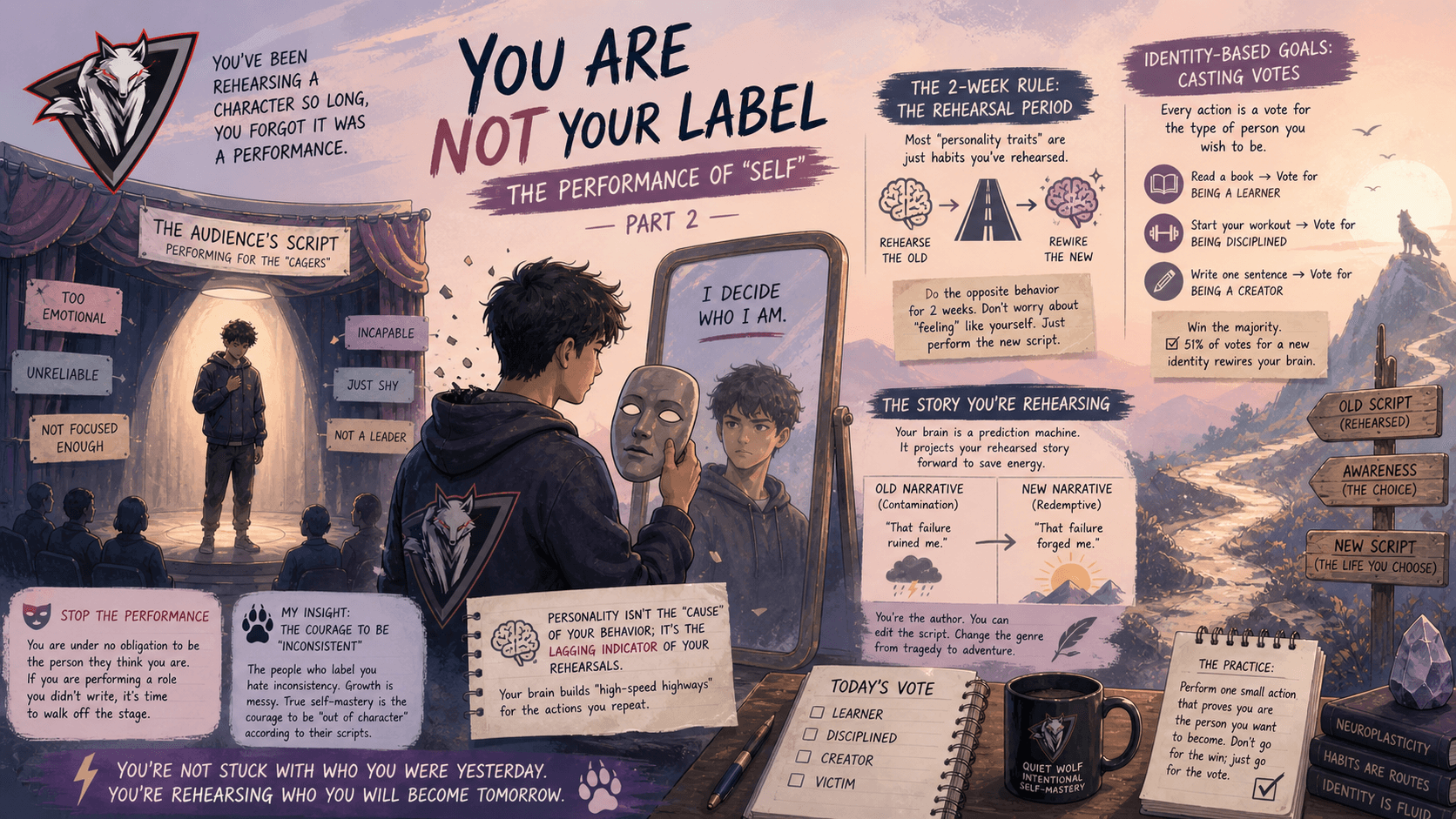
We often speak about our personality as if it’s a fixed geological formation—like a mountain range that was formed millions of years ago and can’t be moved. But the reality is that your "self" is more like a rehearsed play. And if you’ve been playing the same role for twenty years, it’s going to feel like "who you are."
But it’s not. It’s just what you’ve practiced.
4. The Audience's Script: Performing for the "Cagers"
Subtitle: When we live the life others have labeled for us.
As we explored in Part 1, there are people who use snippets of books and social media reels to cage you in a label. The danger isn't just that they judge you—it's that you start to perform the character they've written.
We've normalized this. When "the many" tell you who you are, it's incredibly easy to slip into that role. Psychologists call this the Golem Effect—low expectations lead to a decrease in performance. You start living down to their labels because fighting them feels exhausting.
And nobody questions it. Nobody says, "Wait—maybe reading one chapter doesn't qualify you to define another human being." It's just accepted. Normal. Expected. But there's nothing normal about performing a version of yourself that someone else scripted.
You are under no obligation to be the person you were 5 minutes ago, and you are certainly under no obligation to be the person they think you are. If you are performing a role you didn't write, it's time to walk off the stage.
🐺 My Insight: The Courage to Be "Inconsistent"
The people who label you hate inconsistency. They want you to stay in the box they built so they can feel smart. But growth is messy and inconsistent. True self-mastery requires the courage to be "out of character" according to their scripts. I had to gather the courage to stop explaining myself to people who were committed to misunderstanding me. My identity is not a debate; it’s a creation.
5. The 2-Week Rule: The Rehearsal Period
Subtitle: Most 'personality traits' are just habits you've rehearsed.
Think about the "shy kid" label. Maybe you were shy at seven years old. People labeled you, you internalized it, and for the next twenty years, you avoided social situations because "I'm just not good at that." We've normalized turning a single childhood moment into a life sentence.
Every time you avoided a conversation, you were rehearsing shyness.
Neuroplasticity tells us that your brain physically rewires based on repeated behaviors. You weren't "born shy"—you practiced it until your brain built a high-speed highway for social avoidance.
🐺 My Insight: Personality is a Muscle
We think personality is the cause of behavior, but it’s often the result. If you work out your "anxiety muscle" every day by overthinking, it gets stronger. But if you start working out your "approach muscle," the highway changes.
"You can let go of the patterns you have practiced."
If you strengthen your fear every day by overthinking, it becomes your default reaction. But just as you learned that response, you can teach yourself a new one. You have the power to abandon old habits and pave a completely new direction.
| The Old Logic | The New Fluid View |
|---|---|
| I am shy | I have a habit of stepping back |
| I am bad at math | I have a habit of giving up on complexity |
| I am a night owl | I have a habit of late-night distraction |
The Practice: Pick one behavior you want to shift. Act in the opposite way for 2 weeks. Don't worry about "feeling" like yourself. Just focus on taking the action. Notice how your self-concept changes by day 14.
6. Identity-Based Goals: Casting Votes
Subtitle: The feedback loop that actually changes who you are.
Most people set outcome-based goals: "I want to lose 10 pounds" or "I want to earn a promotion." These are fine, but they are fragile. They create a "finish line" mentality—once you reach the goal (or fail to), you usually revert to your old habits because you haven't changed how you see yourself.
Identity-based goals are different. They don't focus on what you want to achieve; they focus on who you want to become.
The "Election" of the Self
Think of your identity not as a fixed stone monument, but as a continuous election. Every action you take is a vote for the type of person you wish to be.
- When you choose to read a book instead of scrolling for 10 minutes, you are casting a vote for being a learner.
- When you start your workout even though you’re tired, you are casting a vote for being disciplined.
- When you sit down to write one single sentence, you are casting a vote for being a writer.
You don't need a landslide victory to change. You don't need to be perfect. You just need to win the majority. If you cast 51% of your votes for a new identity, your brain eventually starts to believe the evidence.
"A new sense of self is built by a simple majority, not perfection."
You don't need a flawless victory. You just need to win the majority of your daily choices. If you consistently choose small actions that align with the person you want to be, your mind eventually accepts the new evidence.
If who you are is decided by your daily actions, what did you choose to align with today?
🐺 The Anatomy of a Vote
Why does this work? Because your brain is a scientist that looks for evidence. If you tell yourself "I am a productive person" but you spend 6 hours on TikTok, your brain sees the lie. But if you do one small productive thing, you provide a tiny piece of proof.
| Goal Type | The Focus | The Evidence Loop |
|---|---|---|
| Outcome-Based | The Result | "I'll be happy when I'm done (if I ever finish)" |
| Process-Based | The Action | "I just need to do the work today" |
| Identity-Based | The Person | "A leader wouldn't leave this mess. I'll fix it." |
🐺 The Youniverse Connection
When you look at your Personality Profile, don't see it as a list of limitations. See it as your starting point.
If your results say you're a "Gentle Servant" (Supine) but you want to be a decisive leader, you don't need to change who you are at your core. You just need to start choosing actions that prove you can be decisive. You aren't pretending—you are simply proving to yourself that you are capable of a different response.
Stop asking: "How do I write a book?" Start asking: "What would a writer do right now?" Maybe they would just sit down and open a blank page. Maybe they'd just write a single sentence. That is your choice. The finished work is just the natural result of the person you became along the way.
The Practice: Decide the type of person you want to be. Today, take one small action that proves you are that person. Don't worry about a massive win; just focus on taking that one step.
7. The Story You're Rehearsing
Subtitle: How the narrative you tell becomes the life you live.
Our minds naturally try to predict the future based on the past. If you constantly repeat the story that you are "unlucky" or "incapable," your mind will filter out opportunities just to keep that old story true.
Research on how we tell our stories shows that those who view their setbacks as painful but necessary steps toward growth experience far greater peace and resilience.
🐺 The Author's Insight
You're not just living a life; you are carrying a script you probably wrote in childhood to protect yourself. But you are the author of your life now. You can change the tone. You can turn a painful event into the exact moment you found your strength.
"You have the power to write your own path to strength."
If you view your past struggles as steps that taught you resilience, then your failures become the very foundation of your strength. You hold the pen.
The Practice: Write your current life story in 3 sentences. Now, rewrite it using the exact same facts, but with a redemptive arc. How does the "failure" from five years ago look when it's the "origin story of your resilience"?
Deep Questions to Ponder
- If your personality is just a set of rehearsed responses, what is one "shy" or "anxious" behavior you are actively practicing every day?
- What is a small, quiet action you can take today that directly contradicts the box others have placed you in? Are you willing to face the discomfort of being "out of character"?
- When you tell the story of your biggest failure, do you frame it as a permanent scar, or as the origin story of your quiet strength?
Stay curious, stay unlabeled. 🐺⚡