"The label you accept is the container you live in."
Whether you realize it or not, you are likely trapped in an identity trap, living inside a set of personality labels. Some you chose for yourself, but many were assigned to you by parents, teachers, and society.
"Your identity is a living canvas, not a finished portrait."
Most people treat their identity as if it were carved in stone—a static monument of who they used to be. A 'thoughtful observer' realizes it is a continuous flow of choices. You can let go of the stories that no longer serve you and write a completely new chapter of who you are at any moment.
Analyze the weight you carry. Which 'Label' is currently exhausting the most of your daily energy?
In this series, we’re going to deconstruct those containers. We’re going to look at the psychology of personality, the science of change, and why you are far more than the sum of your test results.
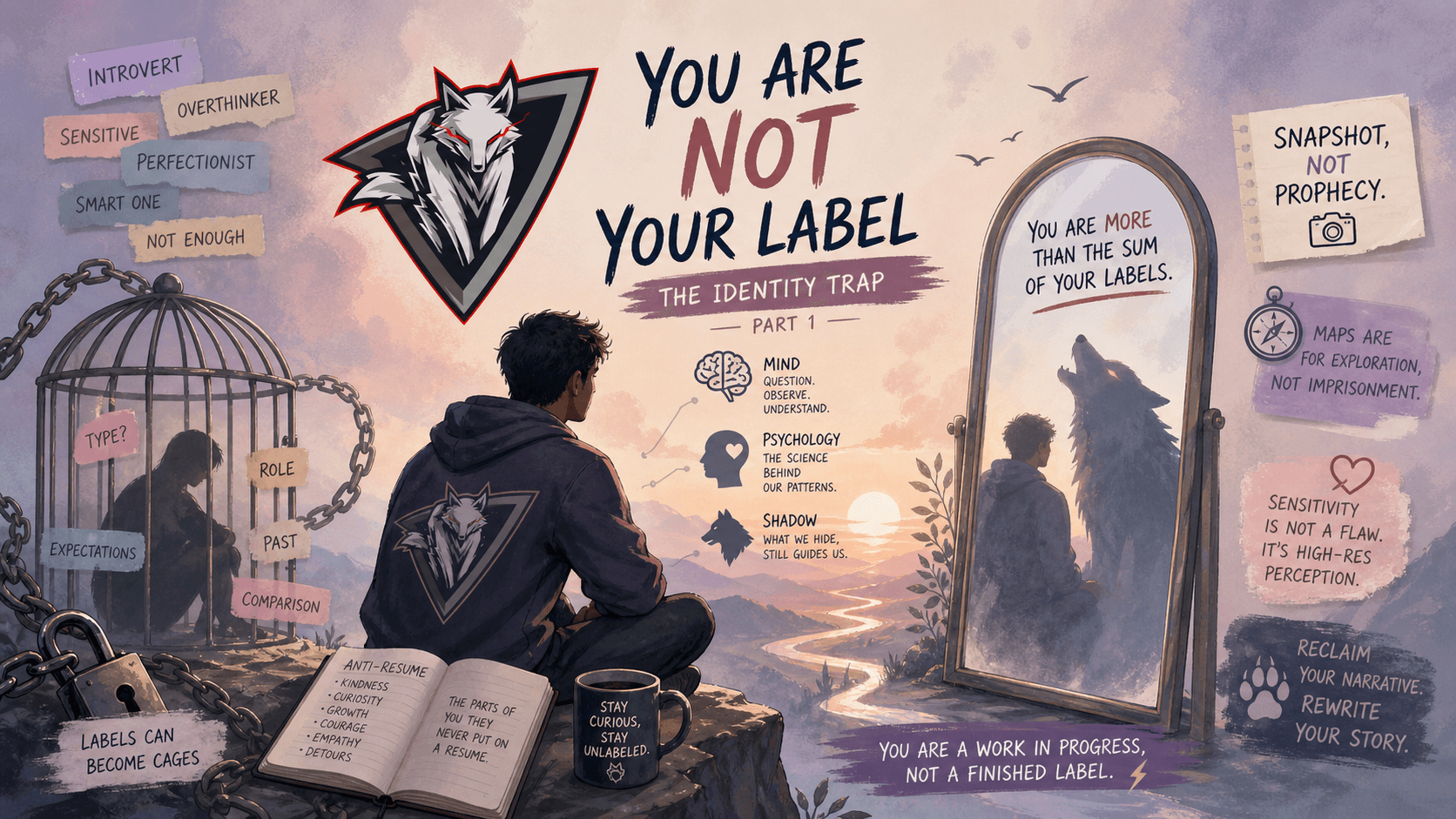
Welcome to the start of a series that's been rattling around my brain for a long time. We're calling it You Are Not Your Label. Because somewhere between childhood praise and adult diagnoses, we started believing the stickers people slapped on our foreheads.
1. The Resume of You: The Lie of Omission
Subtitle: How we reduce ourselves to bullet points and forget the between-the-lines stuff.
Your resume is a masterpiece of curation. It's the high-resolution version of your professional life, polished until it shines. But here’s the problem: you’ve started believing it’s the whole story.
"Your public achievements are just the surface; they omit the heavy lifting beneath."
The setbacks, the silent terror, and the quiet choices to keep going are where your real strength is built. A polished facade might impress the crowd, but only a deep, quiet resilience carries you through the crisis.
Research shows that 55% of people say their self-worth relies heavily on external perception. We internalize this early. As kids, approval meant survival. As adults, that survival instinct has morphed into a "Resume Culture" where we only exist if we can be summarized in bullet points.
| Your Resume Captures | Your Resume Omits (The Real You) |
|---|---|
| Where you worked | The failure that taught you resilience |
| What you achieved | The quiet moments you chose kindness |
| Skills you acquired | The times you were terrified but did it |
| External Credentials | The "between-the-lines" character |
🐺 My Insight: The "Bling Pack" of Identity
We treat our labels like a "bling pack"—we decorate them with achievements and praise to make them feel more real. But the more you decorate the container, the less you look at what's inside. Creativity, empathy, curiosity—these don't fit on LinkedIn. They don't have a "Years of Experience" metric. But they are the very things that define you.
The Practice: Write your anti-resume. List everything valuable about you that would never appear on a job application. The detour that changed your values? Put it there.
Which of these behaviors does your current 'Label' fail to explain?
2. The Personality Test Trap: Snapshots, Not Prophecies
Subtitle: Why MBTI, Enneagram, and even my own Youniverse tests can become cages.
I love personality tests. I built an entire platform called Youniverse because I believe in the power of self-discovery. But there is a massive difference between using a map to explore a city and using a map to build a prison.
The platform is now live at youniverse.wolvesbyte.com! Go there to explore all assessments and map your dimensions.
| The Problem | The Reality Check | | ------------------- | ---------------------------------------- | | Forer Effect | Vague statements feel "so me" | | Self-Fulfilling | "I'm an introvert, so I won't go out" | | Concept Creep | "I'm a Scorpio, that's why I'm unhinged" | | Labeling | Using a four-letter code as a ceiling |
🐺 The Youniverse Connection
On my platform, we talk about dimensions. You are not just a "type"; you are a constellation of Love Languages, Intelligence Types, and Temperaments.
A personality test is a snapshot of how your brain is currently calibrated. It is not a prophecy of who you must be tomorrow. If your label becomes an excuse for not growing, you've turned a tool into a cage.
"A personality test is a momentary map, not a set of borders."
Don't turn a helpful guide into a cage. Self-discovery tools are meant to help you explore the depths of who you are, not to dictate the boundaries of who you are allowed to become.
The Practice: Take your latest result (go to Youniverse if you need a fresh one) and write down three behaviors it doesn't explain. Those are your escape hatches.
3. Weaponized Labeling: The Cage of Superficial Knowledge
Subtitle: When people use "knowledge" not to connect, but to control.
I’ve spent time in environments where personality tests and temperaments weren't used as bridges, but as weapons. I’ve known people who would read a single chapter of a book or watch a 60-second social media reel and suddenly decide they had the "Full Map" of who I was.
They would slap a label on me—"Oh, you're just a typical [Type]," or "That's just your [Temperament] talking"—and use it to dismiss my thoughts, my feelings, and my potential. I was a victim of this for a long time, and it affected me deeply. It’s one thing to be judged by strangers; it’s another to be "caged" by people who claim to have "knowledge" of your soul based on a thumbnail of information.
The Toxicity of the "Many"
Again and again, I tried to explain it to them. I tried to show them that personality books are just guidelines for us to easily connect with others. They are a starting point—a way to understand what to expect so we can connect more deeply and genuinely. They are maps for exploration, not blueprints for a prison.
But sadly, no. They continued to use their so-called knowledge to judge, to label, and to cage others. When you are surrounded by people who constantly label you based on the latest reel they watched, you start to suffer from a specific kind of Imposter Syndrome. You begin to question your own reality. You think, "They are many, and I am one. Maybe they see something I don't. Maybe I really am just this narrow set of traits they've assigned to me."
Labeling others based on superficial "reel-level" knowledge is the ultimate form of intellectual laziness. It’s an attempt to skip the hard work of actually knowing someone by replacing them with a stereotype.
🐺 The Escape: Reclaiming the Narrative
Thankfully, I gathered the courage to escape that toxic environment. I realized that personality books are meant to be guidelines for connection, not cages for judgment. They are a starting point to help us connect deeply and genuinely, not a ceiling to keep us small.
The Practice: If you feel "caged" by what others say about you, ask yourself: "Am I listening to their labels because they are true, or just because they are loud?" Your identity is yours to define, not theirs to assign.
4. You're Not "Too Sensitive"
Subtitle: Reclaiming sensitivity as a skill, not a flaw.
If you've ever been told you're "too sensitive," you've probably been treated like a volume knob that needs to be turned down. But sensitivity isn't a volume issue; it's a resolution issue.
Research into human perception shows that nearly a fifth of the population processes their surroundings and emotions far more deeply than the rest. This leads to higher creativity and empathy, but it also means we suffer more in toxic, heavily labeled environments.
🐺 The High-Contrast Insight
Imagine walking through a room with high-contrast vision. You notice every shadow, every subtle shift in light, and every unexpressed feeling in the air. You aren't "broken" because you see the details others miss—you are simply seeing the world in a richer, deeper way. They called you "too sensitive" because they couldn't handle the depth of what you were picking up.
"Sensitivity is deep awareness, not a weakness."
You aren't 'too sensitive'; you possess a deep and quiet perception. Stop trying to dim your awareness just to make others feel comfortable, and start honoring the richness of what you see.
| Old Label | New Reframe |
|---|---|
| "Too Sensitive" | Deep Awareness |
| "Overwhelmed" | Deep Processing of the World |
| "Moody" | Emotional Depth |
The Practice: Next time you feel overwhelmed, don't say "I'm too sensitive." Say: "I have high-resolution perception. What am I picking up that others are missing?"
Deep Questions to Ponder
- Who told you who you are, and what makes them qualified to write your story?
- If you gave up the convenience of the labels you complain about (like "I'm just a quiet person who can't speak up"), what responsibilities would you have to face?
- Is your sensitivity a superpower you are actively honoring, or is it a shield you are using to hide from the friction of taking action?
Stay curious, stay unlabeled. 🐺⚡