Summary
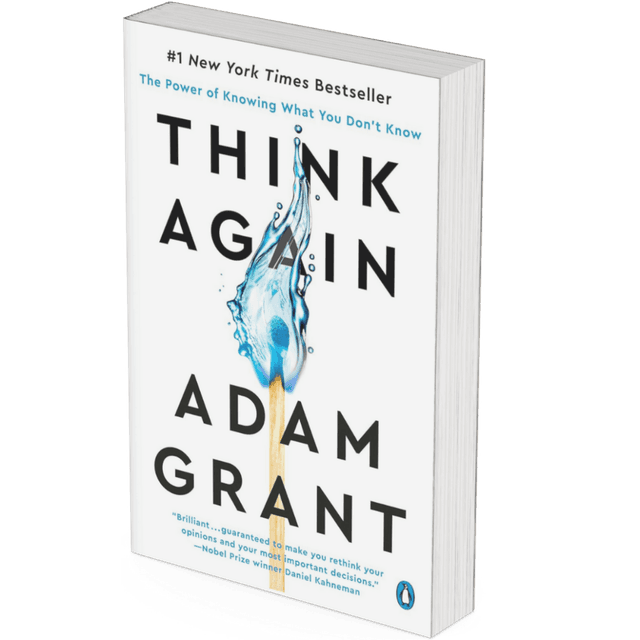
Think Again by Adam Grant is a compelling exploration of the power of rethinking and the importance of intellectual humility. Grant argues that in a rapidly changing world, the ability to think again—to question our assumptions, update our beliefs, and change our minds—is more valuable than ever.
"The goal is not to be right or wrong, but to get it right. And the best way to get it right is to think again."
The book is structured around three main sections: Individual Rethinking, Interpersonal Rethinking, and Collective Rethinking. Grant provides practical strategies for developing the mental flexibility needed to thrive in an uncertain world.
Key Insights
The Three Modes of Thinking
Grant identifies three different thinking modes:
- Preacher Mode - When we're trying to convince others of our beliefs
- Prosecutor Mode - When we're trying to prove others wrong
- Politician Mode - When we're trying to win others' approval
The key is to shift into Scientist Mode - when we're trying to discover the truth, even if it means changing our minds.
The Dunning-Kruger Effect
Grant explores how overconfidence can be a barrier to learning and growth. The more we know about a topic, the more we realize how much we don't know. This intellectual humility is crucial for continued learning and development.
The Power of "I Don't Know"
Grant argues that saying "I don't know" is not a sign of weakness but of strength. It opens the door to learning and growth, and it makes us more trustworthy to others.
Personal Reflection
This book challenged many of my assumptions about intelligence and expertise. I realized that I often operated in "preacher mode," trying to convince others of my beliefs rather than genuinely exploring the truth.
The most impactful concept was the idea that changing your mind is a sign of growth, not weakness. I used to see changing my mind as admitting I was wrong, but Grant reframes it as evidence of learning and intellectual growth.
The section on "confident humility" was particularly valuable. I learned that you can be confident in your abilities while remaining humble about your knowledge. This has made me a better collaborator and learner.
Key Lessons
- Intellectual humility is a strength - Admitting what you don't know opens doors to learning
- Changing your mind is growth - It's evidence that you're learning and evolving
- Confidence and humility can coexist - You can be confident in your abilities while remaining humble about your knowledge
- Question your assumptions - Regularly challenge your beliefs and seek evidence that contradicts them
- Embrace being wrong - Being wrong is an opportunity to learn and grow
Practical Applications
Since reading this book, I've implemented several strategies:
- Regular assumption audits: Questioning my beliefs and seeking contradictory evidence
- Seeking disconfirming evidence: Actively looking for information that challenges my views
- Asking "What if I'm wrong?": Regularly considering alternative perspectives
- Embracing feedback: Viewing criticism as an opportunity to learn and improve
- Practicing intellectual humility: Admitting when I don't know something
Favorite Quotes
"The goal of thinking is not to be right, but to get it right."
"The hallmark of an open mind is not taking one's own side in an argument."
"The best way to get people to change their minds is to first show them that you understand their perspective."
"Confidence is a measure of how much you believe in yourself. Humility is a measure of how much you believe in others."
Rating and Recommendation
I give this book a 4/5 rating. It's a thought-provoking and practical guide to developing intellectual humility and the ability to think again. The concepts are well-researched and the strategies are immediately applicable.
I would highly recommend this book to anyone who:
- Wants to become a better learner and thinker
- Struggles with being wrong or changing their mind
- Wants to improve their decision-making abilities
- Works in teams or collaborative environments
- Wants to develop greater intellectual humility
The book is particularly valuable for leaders, educators, and anyone whose success depends on their ability to learn, adapt, and collaborate effectively.
Rethink Routines
| Practice | Prompt | Cadence |
|---|---|---|
| Assumption audit | What would disconfirm my view? | Weekly |
| Red team session | Argue the opposite case | Biweekly |
| Pre‑commit to update | If X evidence appears, I’ll change | As needed |
| Feedback sprint | Ask 3 people: “One thing to improve?” | Monthly |