Hello~~ 😸, have you ever noticed the internal vocabulary you use when you're alone? To experience true growth, we must learn the language of change and rewrite the static descriptions we tell ourselves.
We've talked about identity, behavior, and social dynamics in this series. But there is a much more fundamental level where labels are born: Language. The words you use to describe yourself aren't just descriptions; they are instructions for your mind.
We've normalized speaking to ourselves in ways we would never speak to someone we love. We say "I am lazy," "I am broken," "I am not enough" — and we treat it like harmless self-talk. But it's not harmless. Every "I am" statement is a command your mind obeys.
"The limits of my language mean the limits of my world."
The Power of "I Am"
"'I am' is the strongest connection in your internal dictionary."
In the human mind, "I am" is more than just an observation. When you say "I am lazy," you aren't just describing a moment of low energy; you are telling your brain to accept laziness as a permanent part of who you are. Stop issuing commands for your own failure.
When you say "I am anxious," you fuse a temporary feeling to your permanent identity. You are essentially telling your subconscious to filter every experience through the lens of anxiety. "I am" is the strongest glue in the world. It takes a fleeting state of being and turns it into a "fixed, set-in-stone" label.
Analyze your 'Internal Vocabulary'. Which of these phrases do you use most often when things go wrong?
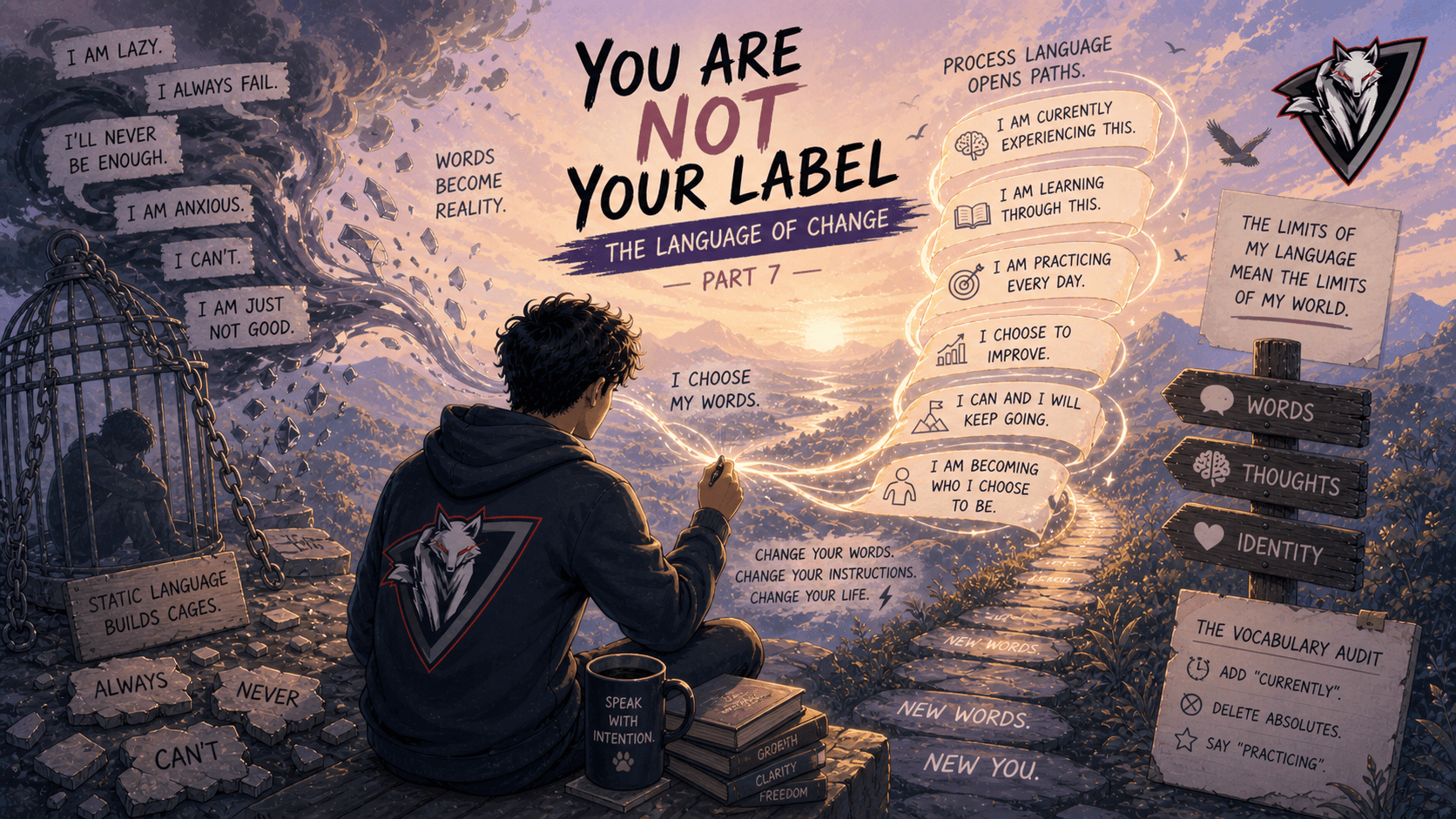
The Absolutes: Always and Never
We often infect our language with absolutes that leave no room for growth. "I always fail at public speaking," or "I’ll never be organized." These words are designed to kill nuance. They take a single point in time and stretch it into an eternal law.
When you use "Always" or "Never," you are telling your future self that change is impossible. You are building a "mental barrier" that blocks any new perspectives or progress from reaching your core identity. You are staying "safe" in your cage by convincing yourself that the door is locked forever.
"Absolutes are the enemy of evolution."
Strike 'Always' and 'Never' from your internal dictionary. These words are designed to keep you small by making your current struggles feel like eternal truths. Change is always possible, but only if your language allows for it.
Moving to Process Language
To break free, we need to move from Static Language to Process Language. This is the art of "reframing" your internal script so it allows for movement, learning, and growth.
| The Static Cage (Labels) | The Process Key (Growth) |
|---|---|
| "I am anxious" | "I am currently experiencing a high state of alertness" |
| "I am a failure" | "I am currently learning through a setback" |
| "I am shy" | "I am currently practicing my social skills" |
| "I am [Label]" | "I am currently feeling [State]" |
Identify a 'Static Label' you used today. How can you rewrite it as a process?
Guidelines, Not Cages
As I’ve said throughout this blog, personality frameworks should be used as guidelines for connection, not cages for judgment. This applies to your internal talk as well. Don't use a personality type to say "I am an [X], so I can't do this." Instead, say "I have an [X] tendency, which means I might need to approach this challenge differently."
The goal is to keep your identity "liquid." You want it to be able to flow and adapt to new situations. By changing your language, you give yourself the permission to be someone different tomorrow than you were yesterday.
The Practice: The Vocabulary Audit
This week, try these three simple shifts:
- Catch the "I Am": Every time you say "I am" followed by something negative, stop. Add the word "currently" to the sentence. "I am currently feeling frustrated."
- Delete the Absolutes: For seven days, don't use the words "Always" or "Never" when talking about yourself. Use "Sometimes" or "Recently" instead.
- The "Practicing" Hack: Instead of saying you're "bad" at something, say you are "practicing" it. "I am practicing being more decisive." It changes you from a victim of a trait to a student of a skill.
Change your words, change your instructions, change your life.
Deep Questions to Ponder
- What "I am" statement have you been repeating so long that you forgot it was a choice and started treating it as a fact?
- If you spoke to a friend the way you speak to yourself internally, would they still want to be around you?
- What would happen if you replaced every "I can't" in your vocabulary with "I haven't learned to yet"?
Stay articulate, stay unlabeled. 🐺⚡