Hello~~ 😸, for the longest time, I was caught in a mirror trap, acting like a different person depending on who I was with. It was exhausting checking mirrors to make sure I wore the right face for the occasion.
We’ve talked about internal scripts and the paradox of consistency in previous parts of this series. But identity doesn't exist in a vacuum. It lives in the mirrors of the people around us.
"I am not who I think I am. I am not who you think I am. I am who I think you think I am."
The Origin of the Looking-Glass Self
"Your 'Social Mirror' is often distorted by the people holding it."
Most of us build our identity based on how we perceive others perceiving us. This is what psychologists call the "Looking-Glass Self." If you are surrounded by "small mirrors"—people who don't see your potential—you will always feel like you have to be small to fit in.
If you were the only person on Earth, would you still have "labels"? Probably not. You would just be. You wouldn't be "introverted," "successful," "sensitive," or "anxious." Those labels only exist in the presence of an observer. We outsource our identity to the people around us, and in doing so, we give them the power to define us.
Identify your 'Primary Mirror'. Whose reflection of you carries the most weight in your daily life?
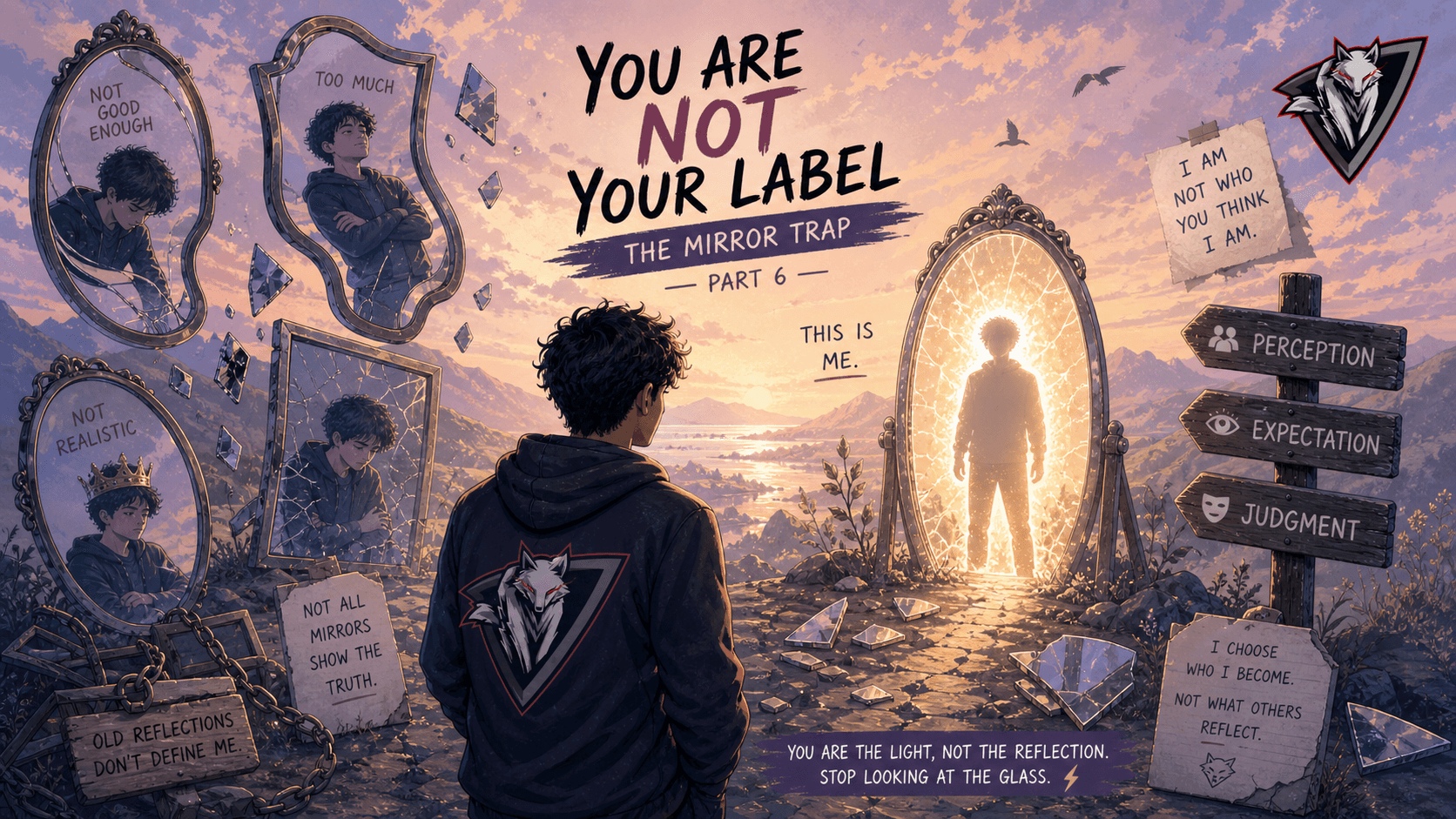
The Hall of Distorted Mirrors
Sociologist Charles Cooley described the process in three steps:
- We imagine how we appear to another person.
- We imagine how that person judges us.
- We develop a feeling about ourselves based on that imagined judgment.
The problem is that most of the mirrors we look into are warped. They are twisted by the other person’s own insecurities, their secret expectations, and their own limited labels. When someone says, "You've changed," what they are often really saying is, "The reflection you are providing is no longer making me feel comfortable." They liked the version of you that was easier for them to manage.
"People who want to control you will always reflect back a version of you that is small and manageable."
Growth is a threat to the people who need you to stay the same. Smashing the mirrors of their expectations is the only way to see your true self.
Breaking Free from the Reflection
When you live in the "Mirror Trap," your self-worth becomes a volatile thing. It goes up when people praise you and crashes when they criticize you. You become a "people-pleaser," constantly adjusting your behavior to get a "better reflection" from the audience.
As I shared throughout this series, I spent years looking at the wrong mirrors — people who reflected back a version of me that was small, weak, and easily categorized. Because they were "the many" and I was one, I started to believe the glass. I thought, "If everyone sees me this way, I must be this way."
But the mirror was warped. I wasn't seeing myself — I was seeing their limitations projected onto me.
Analyze your 'Social Mirror'. Which one is currently giving you the most distorted data about yourself?
A mirror can only show you your surface. It cannot show you your depth, your intent, or your future. If you don’t like the reflection you see in a specific group of people, stop looking at those mirrors.
The Practice: Internal Validation
To break the Mirror Trap, you have to move your "source of truth" from the outside to the inside.
- Audit Your Mirrors: Who are the 5 people you spend the most time with? What "label" do they reflect back to you? Is that label helping you grow, or keeping you small?
- The 24-Hour Mirror Fast: Try to go a full day without seeking a reflection. Don't post on social media, don't ask for feedback, and don't try to "read the room." Just act according to your internal values.
- The Internal Check-In: At the end of the day, ask yourself: "Did I act in alignment with my values today?" If the answer is yes, then the external reflection doesn't matter.
You are the light, not the reflection. Stop looking at the glass.
Deep Questions to Ponder
- If the five people closest to you were mirrors, what version of you are they reflecting back? Is it the version you want to grow into, or the version they need you to stay?
- When was the last time you made a decision without checking how someone else would react to it first?
- What would change in your life if you stopped asking "How do they see me?" and started asking "How do I see myself?"
Stay clear, stay unlabeled. 🐺⚡