"The hardest person to break up with is the version of yourself you've outgrown."
Welcome to Season 2 of the series, where we address the consistency paradox. In Season 1, we deconstructed the containers and scripts; now, we enter the mastery phase of breaking out of character.
"Consistency can quietly become a cage that keeps you loyal to a version of yourself you've outgrown."
The more you cling to your past identity in the name of being "consistent," the less room you leave for your future self to emerge. Growth is the act of being "out of character" until the new character becomes your natural way of being.
Who are you being 'consistent' for right now?
Today, we're tackling one of the most subtle psychological cages of all: Consistency.
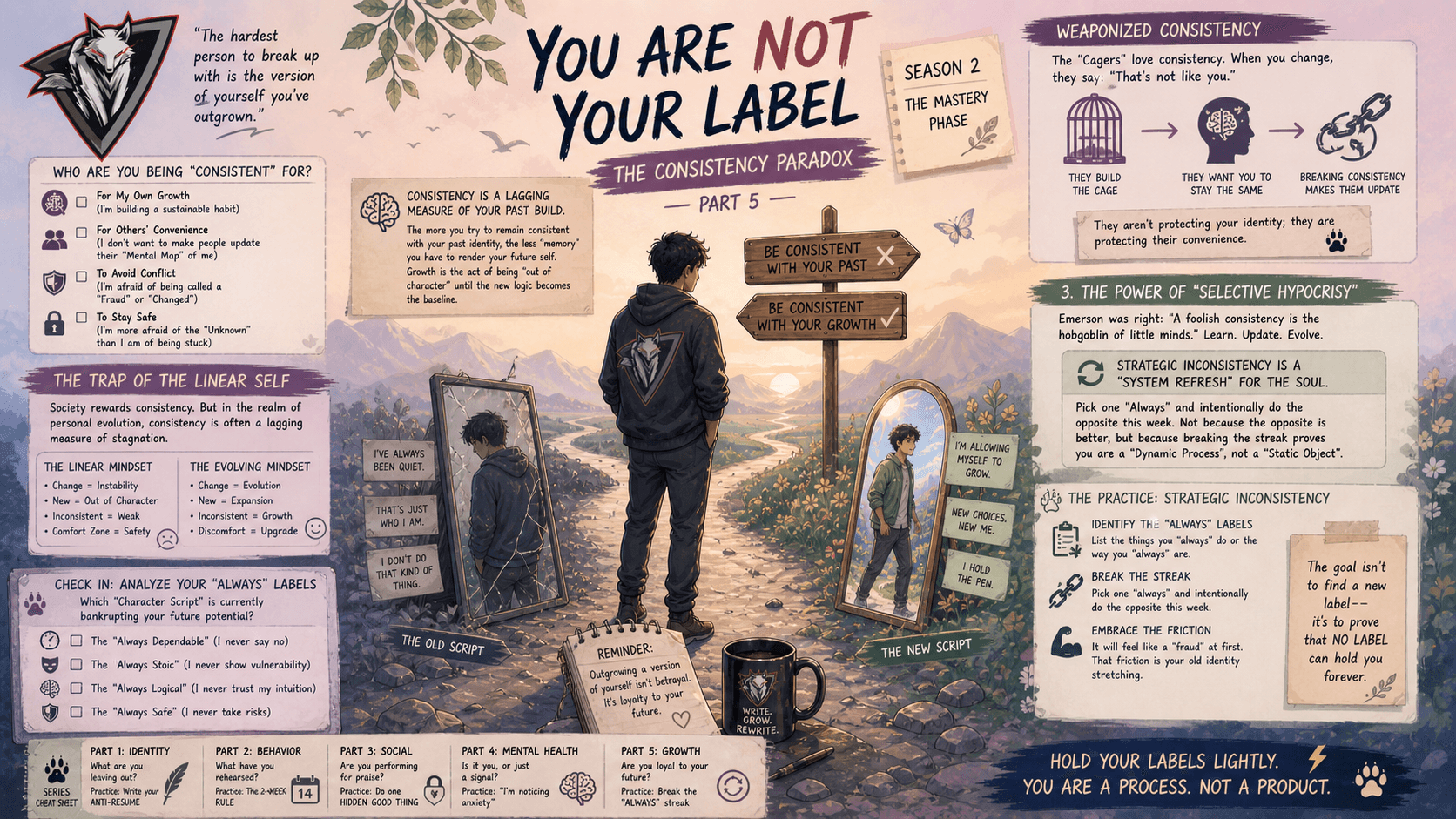
The Trap of the Linear Self
Society rewards consistency. We trust people who are "reliable," "predictable," and "steady." We're taught that changing our minds is a sign of weakness and that "staying true to yourself" means never deviating from the person you were yesterday.
But in the realm of personal evolution, consistency is often just a polished form of stagnation.
The Consistency Paradox is this: The more you try to remain consistent with your past identity, the less space you have to become your future self. We avoid trying new things, speaking in new ways, or adopting new values because they feel "out of character."
"You are a living, evolving person—not a finished portrait hanging on a wall."
The idea that you should stay the same person forever is comforting for the people around you, but it is a disaster for your own growth. If you never allow yourself to change, you eventually become someone who is stuck in the past while the world moves forward without you.
🐺 My Insight: The "Character" Debt
We treat our past selves like a debt we have to keep paying off. We think, "I've always been the shy one, so if I speak up now, I'm being a fraud." We are more afraid of being "inconsistent" than we are of being stuck.
But growth is inconsistency. It is the act of being "out of character" until the new character becomes the baseline.
Which 'Always' label is currently holding your growth hostage?
Weaponized Consistency
In Season 1, I talked about the "Cagers"—people who use labels to keep you small. These people are the biggest proponents of consistency. When you start to change, they are the first to say: "That's not like you," or "You've changed."
They aren't protecting your identity; they are protecting their convenience. It's easier for them if you stay in the box they built. When you break consistency, you force them to update their mental image of you, and most people are too lazy for that.
"Stop treating your past self like a debt you have to keep paying off."
True growth requires the courage to look like a "hypocrite" in the eyes of your past. Breaking a long-standing pattern doesn't mean you are being fake—it means you are finally choosing yourself over other people's comfort.
Ask yourself: Who am I being "consistent" for? Is it for my own growth, or is it to avoid making the people around me uncomfortable? If your consistency is a service to others at the expense of your evolution, it's a cage.
The Power of "Selective Hypocrisy"
To grow, you must be willing to contradict yourself. Ralph Waldo Emerson once said, "A foolish consistency is the hobgoblin of little minds." He was right. If you learn new information today that renders your yesterday-self incorrect, the only noble act is to be inconsistent.
🐺 The Identity Shift
Think of your identity as a living, breathing thing. Sometimes, genuine growth demands that you act in a way that completely contradicts the person you used to be. Your old self might "disagree" with your new choices, but that doesn't make the new choices fake—it means you are genuinely evolving.
"Intentional inconsistency is one of the most powerful acts of self-ownership."
Pick one of your "always" patterns and intentionally do the opposite this week. Not because the opposite is necessarily better, but because breaking the pattern proves to yourself that you are a living, growing person—not a frozen character in someone else's story.
The Practice: Strategic Inconsistency
True growth requires the courage to look like a "hypocrite" in the eyes of your past.
- Identify the "Always" Labels: List the things you "always" do or the way you "always" are. (e.g., "I'm always the one who stays late," "I'm always the quiet one").
- Break the Pattern: Pick one "always" and intentionally do the opposite this week. Not because the opposite is better, but because breaking the pattern proves you hold the pen.
- Embrace the Friction: It will feel like you are being a "fraud" at first. That friction isn't a sign of being fake; it's the growing pains of your old identity stretching to make room for someone new.
The goal isn't to find a new label—it's to prove that no label can hold you forever.
Deep Questions to Ponder
- What is one thing you stopped doing — not because you lost interest, but because someone said "that's not like you"?
- If the people around you celebrated your inconsistency instead of punishing it, what would you try tomorrow?
- Are you staying "consistent" for your own growth, or to make someone else's version of you easier to manage?
Stay inconsistent, stay curious. 🐺⚡