Hello~~ 😸, we’ve killed the myth of the Muse and built our Sanctuary for focus. Now, we must perform the most difficult—and most important—part of the creative process: The Sacrifice.
"To write is human, to edit is divine."
Most people believe that "writing" is the act of putting words onto a page. But the real writing actually happens in the deletion phase. It happens when you take your messy, long-winded first draft and ruthlessly cut away everything that isn't essential.
The Art of Subtraction
"Editing is the process of finding the signal in the noise."
If drafting is about "pouring" your thoughts out, editing is about "polishing" the message. Your goal isn't to add more; it's to remove every word that doesn't serve the primary purpose of the piece. Clarity is born from what you leave out.
The difference between an amateur and a professional isn't found in the first draft—it's found in the ruthlessness of the edit. Most people are too in love with their own sentences to cut the fat. But in writing, the fat is what hides the bone. You have to be willing to let go of your "beautiful" metaphors if they are getting in the way of the truth.
Analyze your 'Editing Ego'. How do you feel when you have to delete a 'clever' but 'useless' sentence?
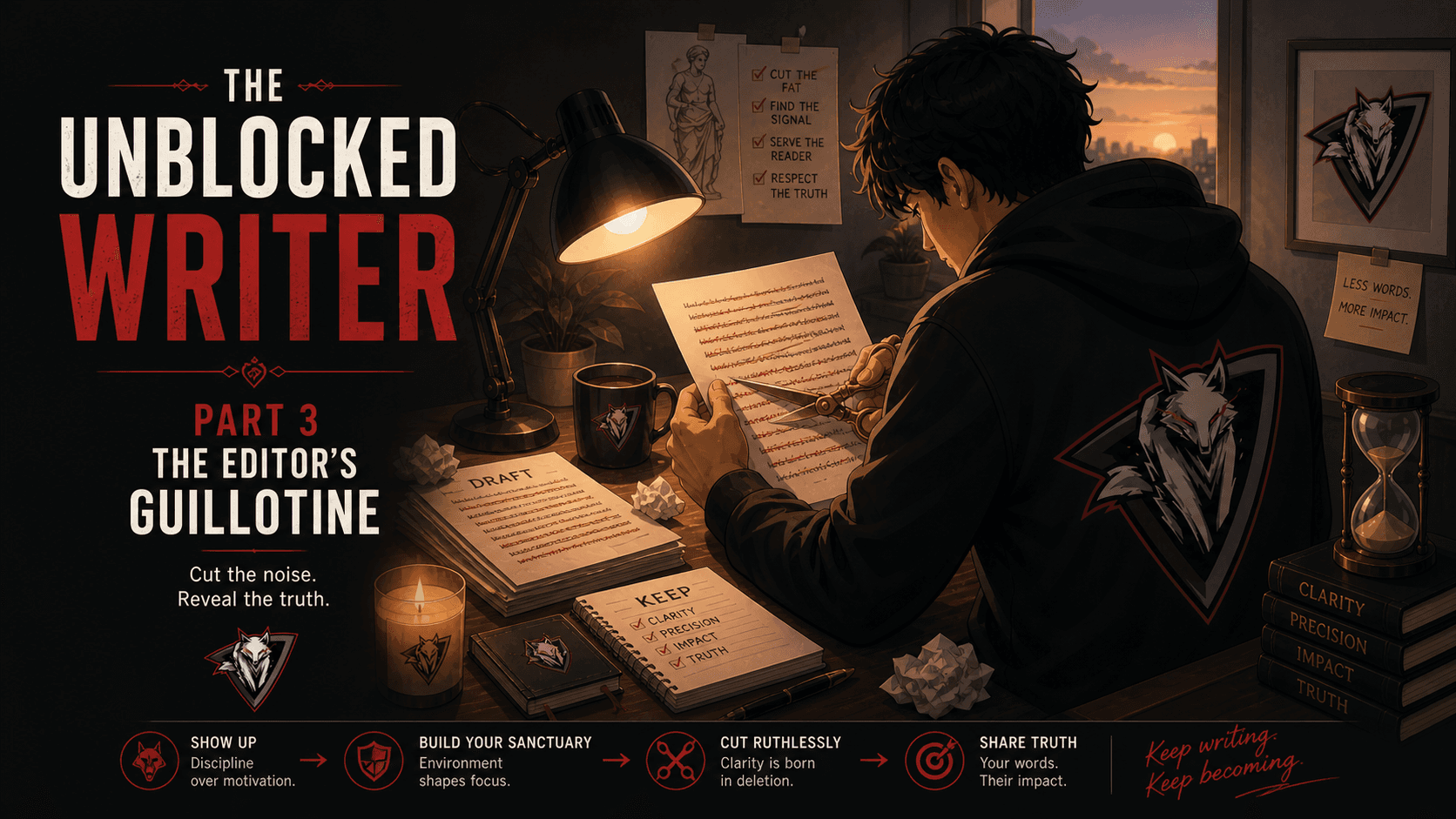
1. Carving the Statue
Most amateurs think that "Good Writing" means adding more adjectives, more complex metaphors, and more "fancy" words. They think of writing as building a wall, brick by brick.
But the pros think of writing like carving a statue. The story is already inside the block of marble (your messy first draft); your job is to remove everything that isn't the statue.
The Rule of 20%:
Try this exercise: Take your finished draft and cut 20% of the words. I promise you, the meaning will stay exactly the same, but the Impact will double. Brevity is a sign of respect for your reader's time and attention.
2. Kill Your Darlings: The Ego Trap
There is always a sentence or a paragraph that you are incredibly proud of. It’s poetic. It’s clever. It makes you look smart.
But if that sentence doesn't serve the core mission of the post—if it’s just there for "show"—you must kill it. This is a psychological battle. You are choosing to sacrifice your ego to save your message.
Ask yourself: "If I remove this paragraph, does the reader lose the 'Aha!' moment?" If the answer is no, then the paragraph is just noise. No matter how much you love it, you must cut it.
"A finished piece should be a concentrated dose of truth."
Your job is to pack the maximum amount of insight into the minimum number of words. This is the ultimate service you can provide to your audience in a world of infinite distraction.
Identify your 'Word Debt'. Which section of your current work feels the most bloated?
3. The "Ear" Audit
Your brain is designed to smooth over errors in text that you wrote yourself. It "knows" what you meant to say, so it ignores the awkward phrasing and the missing commas. But your ears are much harder to trick.
Read your work aloud.
- The Stumble: If you stumble over a sentence, it’s broken. Fix the rhythm.
- The Breath: If you run out of breath before you hit the period, the sentence is too long. Break it up.
- The Music: Writing is music. If every sentence is the same length, it's boring. Use short sentences for impact and long sentences for flow.
Series Wrap-Up: The Disciplined Creator
Writing isn't about being "gifted." It's about being disciplined enough to sit at the desk when you don't feel like it, and ruthless enough to cut your own work when it doesn't serve the truth.
The "Unblocked Writer" isn't someone who never gets stuck; they are someone who has a system for getting unstuck. They treat their words as tools, not as precious parts of their soul.
Keep carving. Keep cutting. Keep moving forward. 🐺✍️