"Intuition isn't a supernatural gift; it's a high-speed architectural system for pattern matching."
For many Ni-dominant types (INFJs and INTJs), the "Aha!" moment feels like magic. A solution appears out of nowhere, fully formed and ready to be implemented. But beneath the surface, your mind has been performing a complex, silent construction project: building a Mental Model.
"Intuition is just 'Implicit Pattern Recognition'."
Your mind is constantly collecting data—even when you aren't paying attention. It builds a lattice of connections between seemingly unrelated concepts. The 'Aha!' moment is simply the point where the lattice becomes strong enough to support a conclusion.
When you solve a complex problem, does it feel like 'Logic' (step-by-step) or 'Vision' (the whole picture at once)?
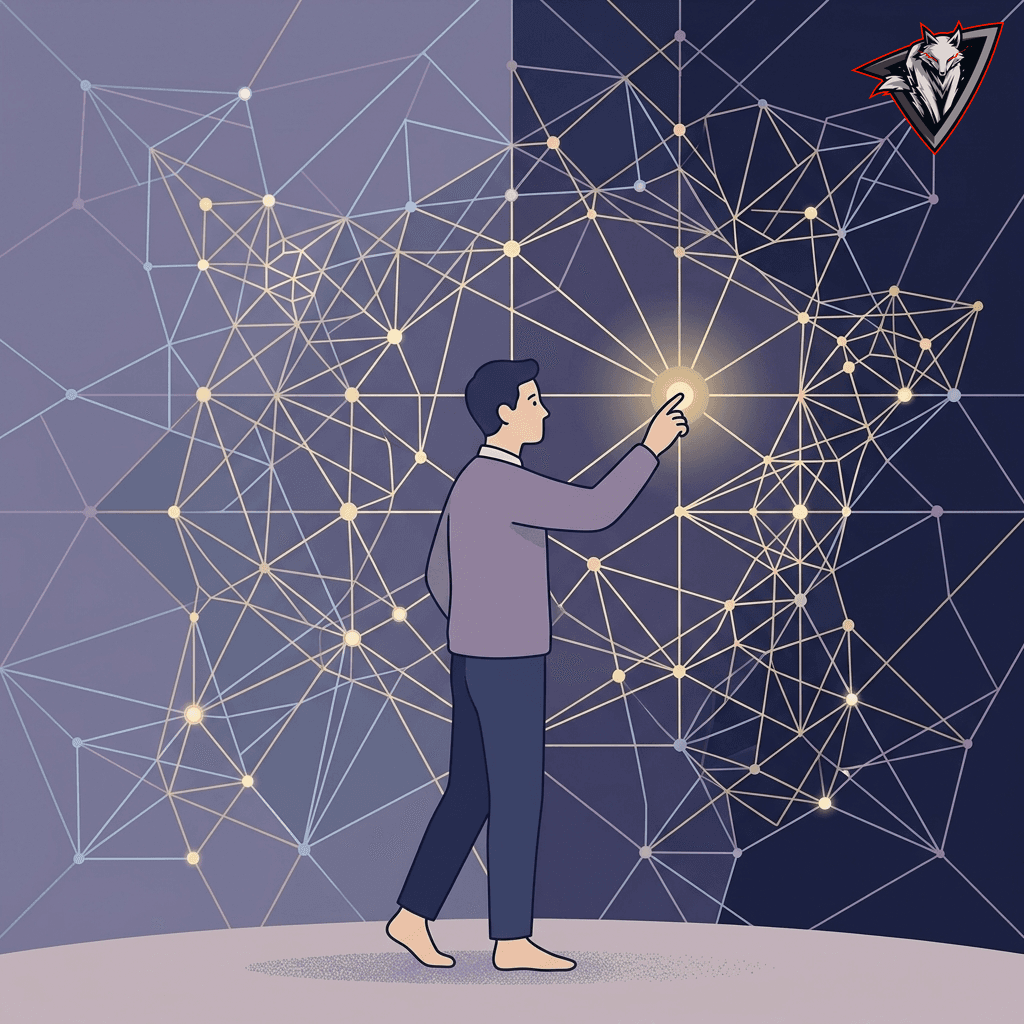
1. The Lattice of Nodes
Think of your intuition as a glowing geometric lattice. Every new experience, every book you read, and every conversation you have is a "Node" in that lattice.
Unlike Si (Introverted Sensing), which stores data as discrete, sequential files, Ni (Introverted Intuition) stores data as Relationships. It doesn't care about the fact itself as much as it cares about how that fact impacts everything else in the model.
"Ni-dominants don't store facts; they store 'Vibrations'."
When a new node is added, the whole lattice vibrates. If the vibration is harmonious, the model is strengthened. If it's discordant, the mind enters a state of inner tension until the model is reshaped.
2. The Silent Construction Site
The reason Ni-dominants often struggle to explain why they know something is because the construction happens in the background. Your conscious mind is the client, but your unconscious mind is the architect.
When you focus on a problem, you are essentially 'stress-testing' the model. You are throwing scenarios at the lattice to see where it breaks. This is why 'sleeping on it' works so well—it gives the architect time to finish the repairs without the client (you) interfering.
3. The Danger of the Perfect Model
The weakness of the intuitive architect is the desire for the model to be Perfect. We can become so attached to the elegance of our internal lattice that we ignore external data that contradicts it.
This is where the "Environmental Overwrite" we discussed earlier becomes dangerous. If your environment is providing false or biased nodes, your intuition will build a perfectly logical but fundamentally wrong model of reality.
Have you ever held onto a 'Mental Model' of someone (or yourself) even when their actions repeatedly proved the model wrong?
4. Reclaiming the Architect
To use your intuition effectively, you must learn to Document the Nodes. As we discussed in the Reclamation Suite, writing down your "Baseline Truths" is how you ensure that the nodes in your lattice are yours, not the world's.
"A healthy Ni is an evolving, adaptable system."
Don't be afraid to let the world break your models. A model that can't be broken is a cage. A model that can be reshaped is a living, breathing map of your evolution.
The Practice: Node Identification
Pick a project or a relationship that feels "stuck." Write down three things you know are true about it, and three things you feel are true. Look at how they connect in your mind.
Are you ready to see the lattice? 🧠🐺